Español
 Pусский


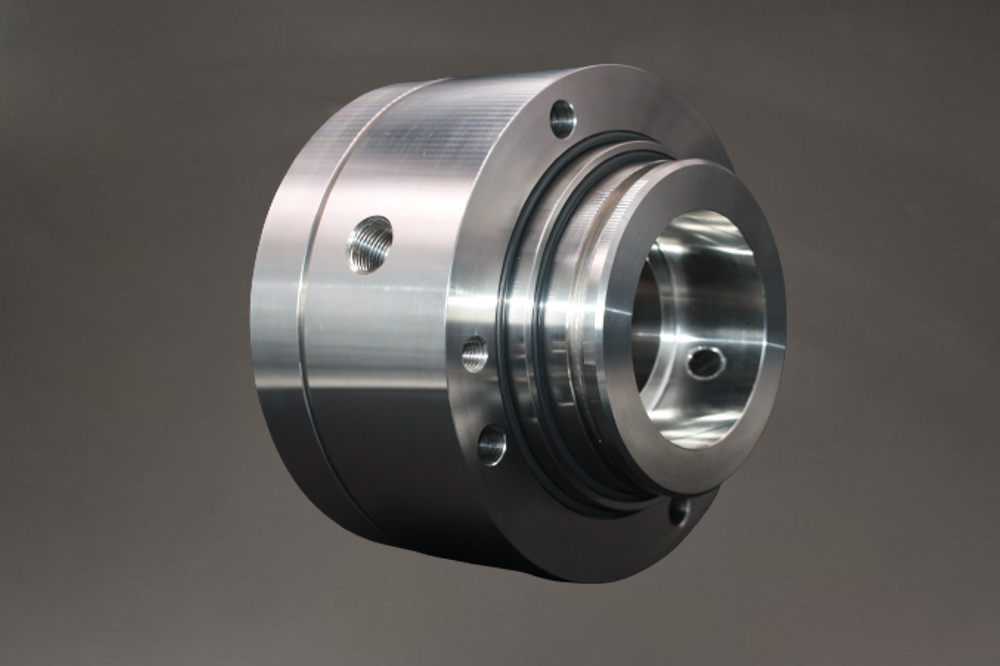
AS-CM74N single cartridge mechanical seal is customized single seal with multiple-spring design.

About Us:


Background Knowledge:
How to choose and use metal parts for mechanical seals (part 1)
(1)Overview:
The metal parts of mechanical seals, such as springs, set screws, transmission parts and metal sleeves, can be the source of seal failures, because the metal parts will corrode rapidly under stress. Commonly used stainless steel springs are susceptible to stress corrosion by chlorides, and there are many chlorides in the world, so some foreign departments suggest not to use stainless steel springs, but to use springs of Hastelloy steel for they are with high corrosion resistance .In addition, spring fatigue caused by improper assembly is another cause of failure.
The fixing screws used in the mechanical seal should not be made of hardened materials, because the heat treatment will reduce the corrosion resistance of the metal, and the softer fixing screws without heat treatment can be fastened tightly to the shaft.
Vibration, deflection, and misalignment will cause the transmission parts to wear. For example, if the sealing surfaces of the mechanical seal stick when being started, the transmission parts will be bent or even damaged, and the heat generated by friction often exacerbates corrosion.
The wear marks on the outer surface of the metal sleeve may be caused by solid particles entering the sleeve from the sealing side, which interfere with the follow-up ability of the mechanical seal. These marks may also be caused by being skewed or being not concentric.
Metal part will change color during temperature rise, so paying attention to the color can get knowledge of the temperature. For example,stainless steel changes colour this way at the following temperatures when using it as the material of metal part of the mechanical seal.
Light yellow----Temperature is 700~800°F (about 370~432°C)
Brown----Temperature is 900~1000°F (about 486~540°C)
Blue----Temperature is 1100°F (about 590°C)
Black----Temperature is 1200°F (about 648°C)
(2)What is the corrosion-resistant cemented carbide in the mechanical seal material
Cobalt-based tungsten carbide is the most widely used cemented carbide for mechanical seals, but WC-Co cemented carbide is not suitable for corrosive occasions. In order to overcome the defect of poor corrosion resistance of the binder phase in WC-Co, a corrosion-resistant cemented carbide with Ni as the binder phase and WC as the hard phase emerged.
The performance of this type of alloy is similar to that of WC-Co cemented carbide, and its corrosion resistance is better. In its chemical composition,WC accounts for 89~94%, Ni accounts for 11~6%.The physical and mechanical properties of WC-Nii are shown in the table below. It has excellent corrosion resistance in acetic acid, sulfuric acid, caustic soda and other media, and has good corrosion resistance in hydrochloric acid and phosphoric acid.

WC-Ni-Cr is usually used to replace WC-Co and WC-Ni. WC-Ni-Cr not only has good corrosion resistance, its strength and hardness are comparable to WC-Co, and it is non-magnetic, so it is a good corrosion-resistant hard alloy in the making of mechanical seals. WC-Ni-Cr has a high thermal conductivity (83.7~58.6W/(m·K)), and a low linear expansion coefficient (4X10¯6~4.5x 10¯6 1/℃). It has good corrosion resistance in hydrochloric acid and in the mixed solution of 55% NaOH and 2% NaCl.
Send Message
Related Products