Español
 Pусский



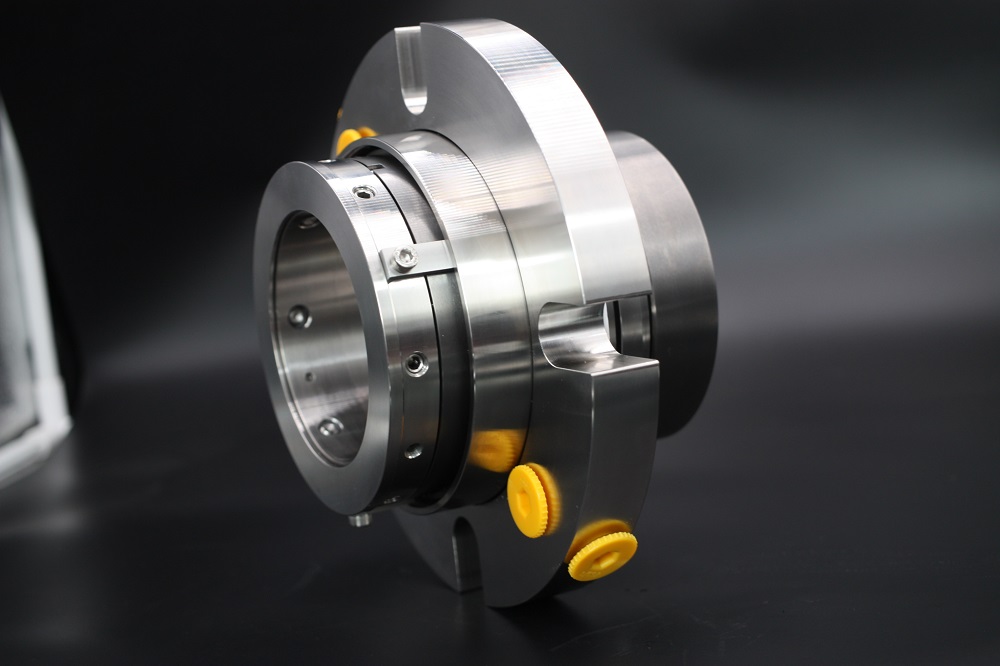
AS-CH222 double cartridge mechanical seal is to replace Chesterton dual seal.

About Us:


Background Knowledge:
Why do mechanical seals use auxiliary facilities?
Auxiliary facilities of mechanical seals are also called cycle protection systems of seals, or simply sealing systems or protection systems of seals.
In fluid machinery (such as pumps, compressors, stirring tanks and centrifuges, etc.), the parts with the harshest working conditions are mechanical seals: they bear axial force like thrust bearings; they export the generated heat like heat exchangers .
The frictional heat generated during the operation of the mechanical seal increases the temperature of the sealing end face. If no corresponding measures are taken, many adverse consequences will occur:
1)As the temperature rises, the liquid film between the sealing end faces of the mechanical seal will vaporize, and the wear will intensify, making the seal fail;
2)The increase in temperature causes thermal deformation of the rotary face & stationary seat of the mechanical seal, increasing both leakage and wear of the seal;
3) The increase in temperature also intensifies the corrosion of the medium on the mechanical seal;
4) The temperature rise causes the auxiliary sealing ring to age, deteriorate and fail;
5) When the temperature rises, the performance of the graphite impregnated with synthetic resin will decrease due to the carbonization of the resin, and the graphite ring impregnated with metal will leak due to the melting of the metal.
It can be seen that the unacceptable temperature rise is the enemy of mechanical seals. It is already difficult to achieve static sealing in high temperature, high pressure, corrosion-prone parts, etc. It is even more difficult to achieve dynamic sealing on the sealing end face of mechanical seals with a width of several millimeters in high-speed rotation.
In order to solve this thorny problem, after a long-term practice, we have found two ways: one is to start with the structures and materials of the mechanical seals to make it suitable for harsh working conditions.The cost of this approach is relatively high, but even so, it still cannot fundamentally solve the problem. Once the mechanical seal fails, the consequences can be serious. Another approach is to improve the working environments through auxiliary facilities. At present, mechanical seals without any auxiliary facilities in actual work are rare. For example,the series mechanical seal used for high pressure and the mechanical seal of high temperature pump must adopt corresponding auxiliary facilities. Through auxiliary facilities, some harsh working environments can be changed to acceptable sealing, so that the performances of mechanical seals are greatly improved, and the application ranges of them also become wider.Next chapters we will discuss it in detail.
In the previous chapters, we have already stated the following conclusions: through auxiliary facilities, some harsh working environments can be changed to acceptable sealing, so that the performances of mechanical seals are greatly improved, and the application ranges of them also become wider.
The purpose of the auxiliary facilities is to reduce the undesired temperature rise, maintain a good lubrication state between the sealing end faces of the mechanical seals, and make the parts of the mechanical seals work well. In the easy-to-vaporize medium, it can ensure the pressure in the sealed cavity that it does not vaporize; it can play the role of heat preservation and heat supply in the seal of the cryopump; it can also be used for the mechanical seal with media of crystallization with solid particles or strong corrosive properties.Therefore, some countries refer to the auxiliary system as the protection system.
Of course, the working temperature, pressure and speed of some mechanical seals are not too high, and they can work without auxiliary facilities. However, from the standpoint of seal stability and service life, it is advantageous to use auxiliary facilities.Therefore, the auxiliary facilities should be regarded as an integral part of the mechanical seals, and different auxiliary facilities should be used according to different working conditions.
The internationally accepted American Petroleum Institute standard (centrifugal pump API610) has made specific regulations on this. Correct and reasonable selection of auxiliary facilities is not only important to advancing stability & prolonging the service life of the mechanical seals but also has certain effects on reducing leakage & maintenance workload and reducing production costs by enhancing safety of production.
That's why auxiliary facilities are also called cycle protection systems, or simply sealing systems or protection systems of mechanical seals.
Send Message
Related Products