Español
 Pусский



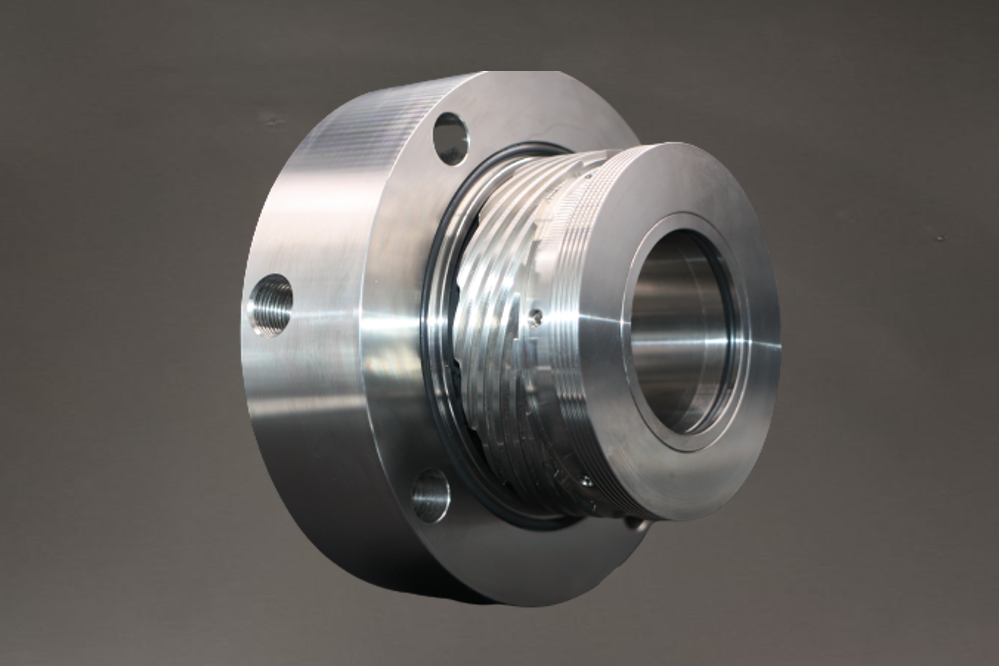
AS-C417 seal is customized single cartridge mechanical seal made as per drawing

About Us:


Background Knowledge:
How to choose and use metal parts for mechanical seals (part 2)
(1)What are the hard alloys for surface welding of mechanical seals?
Welding a layer of hard alloy on the surfaces of the sealing rings of the mechanical seals
can improve their wear resistance and corrosion resistance , and this action’s prices are low, so it is a common practice. The hard alloys used for surfacing include chromium-based No. 1, cobalt-based No. 1 and cobalt-based No. 2. Their composition and properties are shown in the table below.
Model | chromium-based No. 1 | cobalt-based No. 1 | cobalt-based No. 2 | chromium-based No. 1 | |
Surface welding & gas welding | Surface welding & gas welding | Surface welding & gas welding | Surface welding & electric welding | ||
Name | SDCrC_1 | SDCoCr_1 | SDCoCr_2 | TDCrC_1 | |
composition % | Cr | 25—31 | 26—32 | 26—32 | 25—31 |
C | 2.5—3.3 | 0.7—1.4 | 0.2—1.7 | 2.5—3.3 | |
Ni | 3.5—5.0 | —— | 2.0——4.0 | 3.5—5.0 | |
Si | 2.8—4.2 | 0.4—2.0 | 0.4—2.0 | 2.8—4.2 | |
Mn | 0.5—1.5 | ≤1.0 | ≤1.0 | 0.5—1.5 | |
Fo | Balance | ≤2.0 | ≤2.0 | Margin | |
W | —— | 3.5—6.0 | 7.0—8.0 | —— | |
Co | —— | Margin | Margin | —— | |
Surfacing layer thickness,HRC | 48—54 | 40—45 | 48—50 | 48—54 | |
Tensile strength,MPa | 350—450 | 350—750 | 500—800 | ||
Shock value,N·m/CM2 | 2.5 | 7.0 | 5.0 | ||
Item Code | —— | Stellite NO.6 | Stellite NO.6 | welding 69A.27—7 welding 181 | |
The chrome-based No. 1 surfacing layer has good cavitation resistance and corrosion resistance; the Co-based No. 1 surfacing layer has high hardness and good acid resistance; the Co-based No. 2 surfacing layer has high temperature resistance and and high hardness at high temperature. Although surfacing hard alloy has certain corrosion resistance, it is not resistant to strong acid and hot alkali corrosion. Besides,its hardness is not high, & its thermal crack resistance is poor, and the surfacing welding process poses quite high requirements, so it is not suitable for mechanical seals whose sealed medium are granular and mechanical seals at high-speed. For the above-mentioned two cases,the heat treatment requirements before and after surfacing welding are relatively strict, and defects such as pores and cracks are prone to occur in this process.
A new type of hard alloy for surface welding has been developed in China. It is F e-Cr-C series, the models are EDZCr55-1 and EDZCr-60, and it is a welding electrode for surfacing welding with high wear resistance, good toughness and crack resistance. The hardness of EDZCr55-1 after surfacing is HRC55, and the impact toughness can reach more than 10N.m/c㎡; the hardness of EDZCr-60 is HRC60, but the toughness is slightly worse. This hard alloy has a simple surfacing process, and both AC and DC welding machines can be used.The preheating temperature of this cemented carbide before welding only needs to be about 200°C, no heat tracing is needed during the welding process, and it needs to be covered with insulating materials after welding only. The electrode is low in price and is a promising hard alloy for surfacing
(2)Which kinds of cemented carbide in the mechanical seal materials can be welded
In order to solve the shortcoming of the shrink-fit sealing ring(a kind of mechanical seal structure) loosening, a kind of cemented carbide that can be welded has emerged in China.It is a chromium carbide cemented carbide (Cr3-C2-Ni) with nickel as the binder phase, and the grade is CN15. Compared with YG6, it has the advantages of light weight (specific gravity 7~7.5), corrosion resistance and oxidation resistance. Because the coefficient of linear expansion (10.2x10¯6 1/°C below 500°C) is similar to that of stainless steel, and the alloy composition belongs to Cr-Ni base, it can be directly welded to the ring seat. When welding, clean the ring seat and the hard alloy ring, and lay a layer of Ni-based powder between them, then place them in a vacuum resistance furnace, sinter at a high temperature of 1100 ° C, keep warm and cool with the furnace, and then process them after tempering to the required size. Its corrosion resistance is shown in the table below.
Grade | 98% HNO3 | 68% HNO6 | 50% H2SO4 | 30% HCl | 38% HNO3+62%H2SO4 | 55% NaOH + 20% NaCl |
CN15 | 0.018 | 0.012 | 0.014 | 0.017 | 0.0017 | 0.041 |
YC6 | 1.710 | 1.494 | 0.20 | 1.12 | 0.085 |
Send Message
Related Products