Español
 Pусский


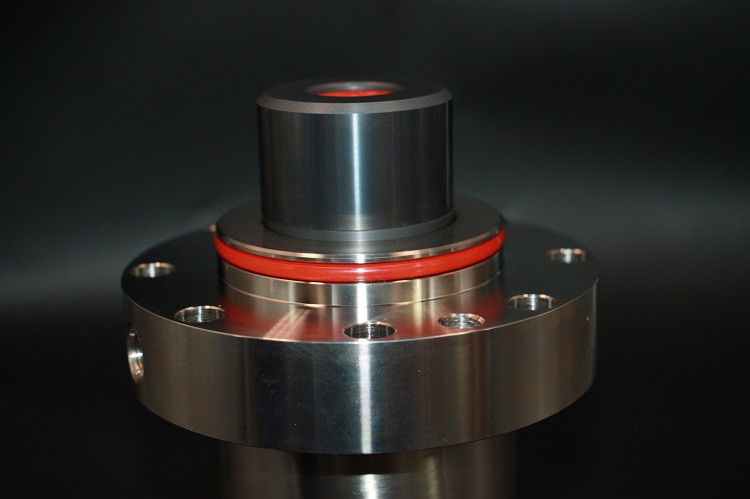
AS-HSMR34 double seal is unbalanced dual seal to replace Burgmann HSMR34 double cartridge mechanical seal.
Operating Limits:
Temperature: t1 = -20 °C … +200 (300) °C
(-4 °F … +392 (572) °F)
Sliding velocity:
vg = max. 10 (20) m/s (33 (66) ft/s)
Pressure:
p1 = vacuum … 14 (23) bar (203 (334) PSI)
p3 = max. 16 (25) bar (232 (363) PSI)
Δ p3-p1 = 2 …10 bar (29 …145 PSI),
higher Δp on request
!Noted that the extremal values of each operating parameter cannot be applied at the same time because of their interaction.
For values in brackets & for applications beyond this range, please inquire.
Material Combinations:
Seal faces: Silicon carbide, in conformance with FDA standards
Seat: Carbon graphite (atmosphere side) resp. Silicon carbide (product side), in conformance with FDA standards
Secondary seals & metallic parts can be customized according to application & customers' needs
Features:
Liquid-lubricated
For top, side & bottom entry drives
Seat at product side rotating
Independent of rotation direction
With or without bearing available
Shaft sleeve not in contact with product (with standard diameters)
Advantages:
Smooth surface, free of dead spaces
Able to operate CIP-/SIP (Cleaning in Place, Sterilization in Place)
Sliding materialscon in conformance with FDA standards
Variant for sterile applications available
Recommended applications:
Petrochemical industry
Chemical industry
Pharmaceutical industry
Food and beverage industry
Reactors
Dryers
Mills
Kneaders
Mixers
Pressure filters

About Us:


Background Knowledge:
How to select the friction pair (end face)materials of the mechanical seals
Mechanical seal materials include friction pair materials, auxiliary seal materials, loaded elastic element materials and other structural materials. Correct and reasonable selection of various materials, especially the material of the (end face) friction pair, is of great significance to ensure the stability of the mechanical seal, prolong its service life, and reduce costs.
So, how to choose the friction pair ( end face)materials of a mechanical seal? We mainly select the corresponding materials according to their properties. So,What are the main properties of friction pair materials of mechanical seals?
(1)Main needed properties of friction pair materials of mechanical seals: physical and mechanical properties, corrosion resistance and tribological properties.
1.1 Physical and mechanical properties: strength, stiffness, thermal conductivity, thermal expansion coefficient, corrosion resistance, tribological properties.
1.2 Corrosion resistance: Among the mechanical seal end face materials, from the perspective of corrosion resistance, excellent materials include graphite materials, engineering ceramic materials, glass fiber filled PTFE materials, etc. It is worth noting that many metal materials with excellent corrosion resistance, such as Hastelloy B and Hastelloy C, are not suitable for use as friction pairs, because they are not accompanied by good tribological properties
1.3 Tribological properties: Friction, wear and lubrication are important parameters for evaluating the tribological performance of the friction pair material of a mechanical seal. The friction coefficient f and the wear rate can reflect the lubrication state of the end face. If the lubrication state is good, the friction coefficient is small and the wear rate is low; On the contrary,the friction coefficient is large and the wear rate is high. At this time, the life of the mechanical seal is short, and the end face heats up severely, and the liquid film vaporizes. In severe cases, the end face will be thermally cracked, resulting in rapid failure of the mechanical seal. Obtaining a low coefficient of friction depends on the self-lubricating ability of the material itself and the lubrication conditions provided by the outside environment.
(2) Commonly used end face friction pair materials are: Graphite, cemented carbide, engineering ceramics, filled PTFE and other end surface friction pair materials.
2.1 Graphite material
There are three material forms of carbon in nature: diamond (crystalline carbon), graphite (crystalline carbon), and coal (amorphous carbon without crystalline characteristics). Graphite is the most widely used friction pair material in mechanical seals. It has many excellent properties, such as good self-lubrication and low friction coefficient, excellent corrosion resistance, good thermal conductivity, low linear expansion coefficient, good assembly performance, easy processing, and can be obtained at low cost. Graphite for mechanical seals is generally made of coke powder and graphite powder (or carbon black) as the base material, pitch as the binder, and sintered at high temperature by molding. According to the different raw materials used, sintering time and sintering temperature, sintered graphite with various mechanical and physical properties can be made, and the common ones are carbon graphite and graphitized graphite. The difference is that graphitized graphite is sintered and needs to be graphitized at a high temperature of 2400-2800 °C.
Carbon graphite: also known as high-strength graphite, hard graphite, etc., is characterized by high strength, high hardness, and wear resistance, but high brittleness and low thermal conductivity. It is the softer ring material of rthe mechanical seal often selected for mechanical seals.
Graphitized graphite: Also known as electrochemical graphite and soft graphite, it is characterized by soft quality, low strength, good self-lubricating performance and easy processing. It is suitable for medium cleaning, but poor lubricating performance, or working conditions prone to dry friction, such as light hydrocarbon medium of the mechanical seal device.
2.2 Cemented Carbide
Cemented carbide is a class of metal carbides produced by powder metallurgy. It relies on some alloying elements, such as cobalt, nickel, steel, etc., as the bonding phase, and sinters and bonds hard phases such as tungsten carbide and titanium carbide at high temperature. Cemented carbide has high hardness (HRA87-94), high strength (its bending strength is generally above 1400MPa), high thermal conductivity and small linear expansion coefficient, and has certain corrosion resistance. Commonly used cemented carbides for mechanical seal friction pairs are: cobalt-based tungsten carbide (WC-Co) cemented carbide, nickel-based tungsten carbide (WC-Ni), nickel-chromium-based (WC-Ni-Cr) tungsten carbide hard alloy cemented carbide, steel-bonded titanium carbide carbide.
2.3 Engineering ceramics
Engineering ceramics is a large class of ceramic materials used in engineering. Its raw materials are artificially prepared, unlike daily-use ceramic materials and chemical ceramics, which are directly taken from natural raw materials. Therefore, its composition and formula are relatively easy to control, and the product quality is stable. The common feature of engineering ceramics is that they all have excellent chemical stability, high hardness and wear resistance, but low impact toughness and high brittleness. At present, alumina ceramics (AI₂O₃), silicon carbide ceramics (SiC) and silicon nitride ceramics (Si₃Ni₄) are mainly used for mechanical seal friction pairs.
2.4 Filled PTFE
Polytetrafluoroethylene (PTFE) is the organic polymer with the best chemical stability, and it can almost resist the corrosion of all strong acids, strong alkalis and strong oxidants. So far only molten alkali metal (or its ammonia solution), elemental fluorine and chlorine trifluoride have been found to interact with tetrafluoroethylene at high temperatures.
In the long molecular chain of polytetrafluoroethylene, the fluorine atoms effectively cover the carbon atoms, reducing the cohesion between the molecules, so that the surface molecules are easy to roll or slide with each other, and have a very low coefficient of friction, which is an excellent Anti-friction, self-lubricating material in mechanical seals making.
The biggest problem with PTFE is that it has cold flow, that is, under the action of load, it will produce permanent deformation and creep with time. In addition, the thermal expansion coefficient of PTFE is large (8-25)×10¯5/℃, which is about 10 times that of steel; the thermal conductivity is very poor (0.244W/m.K), which is only 1/200 of steel. In order to overcome these shortcomings, it is usually to add an appropriate amount of various fillers to PTFE to form filled PTFE. The most commonly used fillers are glass fiber, graphite, etc. Filled PTFE sealing rings of mechanical seals are often used in aggressive media environments. The PTFE ring filled with 20% glass fiber can be combined with a variety of ceramic materials, such as chrome corundum ceramics, and the application effect is very good in dilute sulfuric acid pumps. Sealing rings filled with 15% glass fiber and 5% graphite are often combined with alumina ceramics. These are adopted for strong corrosive media. The sealing ring of mechanical seals filled with 15% titanium dioxide, 5% glass fiber and silicon carbide is suitable for sulfuric acid and nitric acid media.
2.5 Other friction pair materials
Materials used for friction pairs of mechanical seals include cast iron, carbon steel, chromium steel, chromium-nickel steel, chromium-nickel-molybdenum steel, tool steel, bearing steel, bronze, etc. The earliest friction pair material for mechanical seals in China's oil refining industry was cast iron versus graphite. Cast iron has good anti-friction and wear-resistant properties, and is low in price and easy to process and manufacture. Ordinary cast iron has poor corrosion resistance and is only suitable for oil and neutral media. Alloyed cast iron formed by adding alloying elements improves corrosion resistance and can be used in many working conditions. Some mechanical seals of a well-known international company use alloy cast iron as the non-rotating ring, and the effect is very good.
Send Message
Related Products