Español
 Pусский



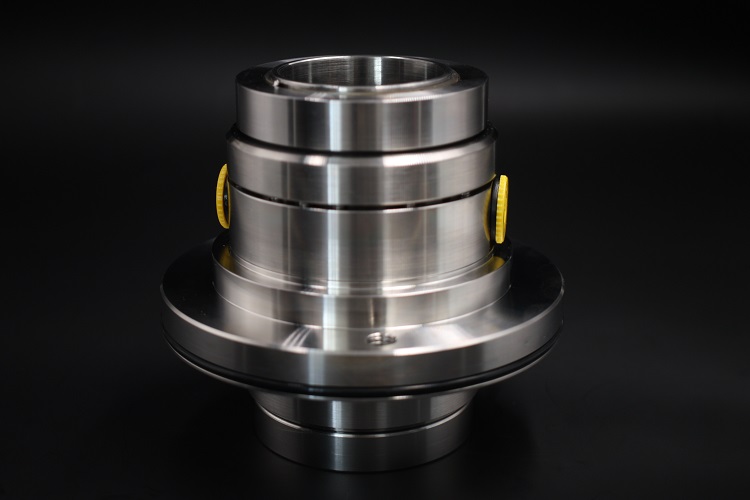
This double seal is to replace Johncrane S2A double cartridge mechanical seal with multiple spring design. Maybe you cannot see this type in its old catalogue or on its website,that's because it is a newly-developed type.

About Us:


Background Knowledge:
Why pumping rings are used in mechanical seal auxiliary systems
In industries such as petroleum refining and chemical industry, more than 80% of the rotating equipment for conveying liquid media adopt mechanical seals. The zero escape, high reliability, long life, and low wear of mechanical seals are the research and development directions in the field of mechanical seals. A well-working mechanical seal auxiliary system is a necessary condition to ensure the long life of the mechanical seal. The auxiliary system scheme stipulated in API682 can basically meet the normal operation of mechanical seals under most working conditions.Among the auxiliary system schemes specified in API682, schemes No. 23 and No. 52/53 (as shown in the figure below), require sealing protection or isolation buffer to be able to circulate to take away the heat generated by the sealing end faces of mechanical seals and reduce the sealing working temperature.
There are three ways to promote the circulation of sealing fluid: (1) Add a small pipeline circulation pump to the system pipeline to complete the circulation; (2) Use thermosiphon effect to form natural flow circulation; (3) A rotating part with a pumping effect —— a pumping ring, is added to the seal to complete the circulation of the sealing fluid. For the circulation method (1), the additional small circulation pump involves a series of problems such as pressure resistance, temperature resistance, sealing, explosion-proof, etc., and the cost investment is relatively large, so it is rarely used in general.
For the (2) circulation mode, a certain temperature difference is required to form a circulation, and the circulation speed is relatively slow, and the effect is not obvious when it is used in the occasions with high speed and high heat generation. It is generally used in occasions with low speed and low heat generation
(3)circulation mode—pumping ring, which is fixed on the rotating part of the mechanical seal and rotates together. The function of the pumping ring is to transfer the buffer liquid in the seal chamber (isolation liquid or self-flushing fluid in the pump chamber) and sent back to the pipeline after passing through the cooler storage tank to meet the requirements of sealing liquid circulation. Compared with the mechanical seal device itself, the cost is very low. Except for very little consumed shaft power, it does not involve other problems. It is economical and practical. So it is widely used in mechanical sealing.
1.Classification of pumping rings
Commonly used pumping rings have two structures: centrifugal and spiral (see the figure below).Centrifugal pumping rings have open groove type, inclined hole type and semicircular groove type (see the figure below). The inclined hole type is designed to increase the flow rate of sealing liquid and reduce fluid resistance, and has requirements for the direction of rotation of the shaft. The spiral type has internal and external spiral fit and only external thread rotation (see the figure below). The latter is more commonly used. The threaded pumping ring has thread rotation requirements, which need to be paid attention to.
2.Working mechanism of pumping ring
The centrifugal pumping ring is to process the liquid outlet groove (or hole) on one side of the metal ring, and use the centrifugal force generated when the pumping ring rotates at high speed to throw out the sealing liquid in the liquid outlet groove (or hole), so that the sealing liquid on the outside of the pumping ring forms a certain pressure, divert out the sealing liquid on the outside of the pumping ring, and at the same time, the sealing liquid on the inside of the pumping ring is continuously replenished into the liquid outlet groove (or hole), forming a continuous pumping effect.The whole working condition of this mechanical seals auxiliary system is similar to that of a centrifugal pump.
The centrifugal pumping ring of the mechanical seal auxiliary system requires that the fluid thrown out by the centrifugal force faces the outlet, and the structure of the outlet has a great influence on the circulation pressure. A common method is to process a groove on the corresponding outer cavity of the mechanical seal auxiliary system.The axial width of the groove includes the axial width of the centrifugal ring. At the same time, the annular groove is not circumferential.and is cut off near the rear side of the outlet hole, so that the fluid is forced to flow to the outlet hole. This design do not require high clearance of the parts.The pressure head outside the centrifugal pumping ring of the mechanical seal auxiliary system is mainly obtained by experiment. The spiral pumping ring is made of multi-threads on the outer surface of the rotating sleeve, which is used in conjunction with the inner surface of the stationary part outside the rotating sleeve (it will be better if the inner surface of the stationary part of the mechanical seal auxiliary system is processed with a thread opposite to that of the pumping ring, but usually due to the narrow space,the processing is difficult, and the inner surface of the stationary part is not threaded,but usually due to the narrow space, the processing is difficult, and the inner surface of the stationary part is not threaded), when the pumping ring of the mechanical seal auxiliary system rotates, the thread will drive the medium in the threaded groove to rotate, and due to the inertia, the medium in the threaded groove and the threaded groove produce relative motion, which promotes the sealing liquid moves to one side, causing a pressure difference on both sides of the pumping ring of the mechanical seal auxiliary system.
This pressure difference can be calculated according to the following formula: Δp=Kρ[zl/(πd)][(V/2)-(Q/F)tgα]²sinα where K——coefficient of pressure head;
ρ——medium density;
z——the number of thread heads;
l——helix length;
d——the diameter of the screw shaft;
V——peripheral speed;
F - flow area;
Q - flow rate including leakage;
α——helix angle.
The sealing liquid on the high-pressure side of the mechanical seal auxiliary system is led out to the external pipeline through the outlet flow channel, and then flows back to the sealing chamber after passing through the heat exchanger or storage tank to form a cycle. The spiral pumping ring does not have high requirements on the outlet of the flow channel, but it also needs to be conducive to the outflow of the sealing liquid. The matching gap between the spiral pumping ring and the inner surface of the outer stationary part of the mechanical seal auxiliary system is sufficient that the pumping ring and the stationary sleeve do not rub against each other during operation, and if the gap is large, the pumping pressure head will be reduced. Since the circulating pressure of the sealing fluid of the mechanical seal auxiliary system has a great relationship with the direction and angle of the outlet of the gland, the flow resistance of the pipeline, and the viscosity of the sealing fluid during the overall circulation process, the detailed calculation is very complicated. The temperature difference between the inlet and outlet pipelines of the sealing liquid of the mechanical seal auxiliary system can be used to determine the working condition of the pumping ring.
Send Message
Related Products