Español
 Pусский



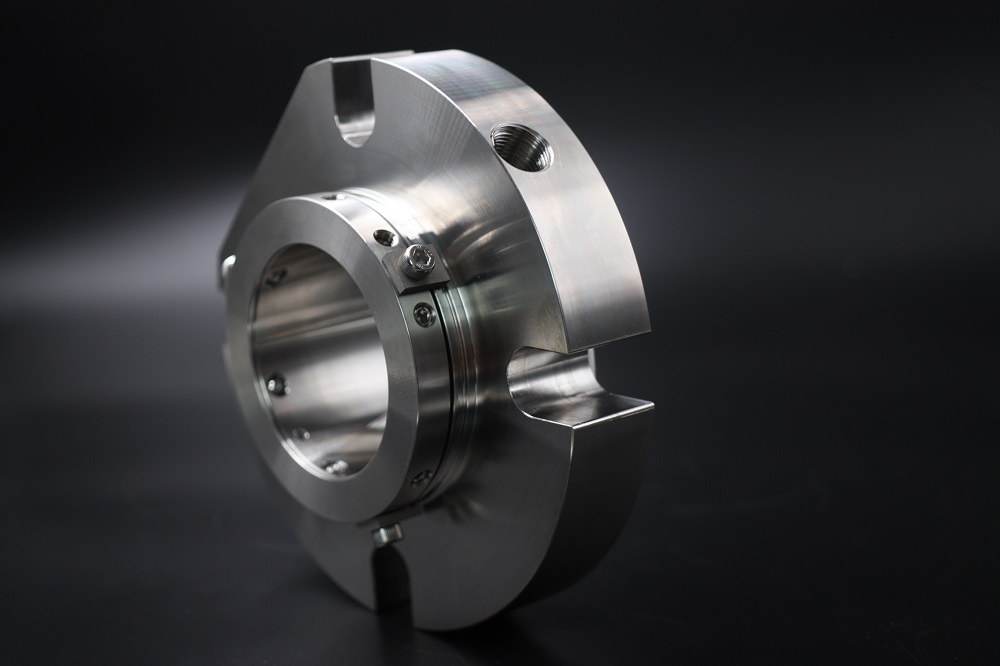
AS-CHS1810 Heavy-Duty Modular Single Cartridge Seal is to replace Chesterton 1810 seal. We also have AS-CHS2810 double cartridge mechanical seal to replace Chesterton 2810 dual seal
Operating Limits:
Pressure 711 mm or 28"Hg Vacuum to 40 bar g (600 psig*)
Temperature –55°C – 300°C (–67°F – 570°F)
Speed 25 m/s (5000 fpm
Sizes 25 mm – 120 mm (1.00"– 4.75)
Material Combinations;
otary Faces CB, SSC, TC
Stationary Faces SSC, TC
Elastomers FKM, EPDM, FEPM, FFKM
Metal Parts 316 Stainless Steel (EN 1.4401)
Springs Alloy C-276 (EN 2.4819)
Features:
Simplified construction & optimized seal performance
Monolithic seal faces help maintain reliability though temperature climbs & drops and through start/ stop processes
Increased face life because of reduced contact stress with cushioned drive pins
Can be tailored to a wide range of process conditions

About Us:


Background Knowledge:
What is vapor phase sealing technologyasa mechanical sealing technology
Vapor phase sealing is a mechanical sealing technology for light hydrocarbons. At present, the vapor phase seal can be used for light hydrocarbons under the following conditions: 1) The vaporization temperature (ie, the boiling point at the sealing pressure) is lower than 55°C; 2) The medium temperature is within the range of 50~75°C; 3) The sealing pressure is within 0.35~5.25MPa.
What are the heating parameters of water vapor for vapor phase sealing?
Heating with steam is the prerequisite for the stable operation of the vapor-phase mechanical seal. It avoids partial liquefaction between the sealing end faces and presents an unstable vapor-like phase. It can also cool the sealing surface when the temperature is too high due to wear, so that the temperature is constant within a certain range, making the mechanical seal work more stable.
What are the parameters of steam heating? It varies according to the heating structure, working temperature and medium type. The parameters of steam adopted by mechanical seal systems used in a factory in the UK and China are introduced respectively.
UK recommended parameters:
Steam temperature: 150~160℃;Steam pressure:0.35~0.5MPa;Steam volume:14kg/h
Steam parameters actually applied in a factory in China:
Steam temperature:100~104℃;Steam pressure:0.01~0.03MPa;Steam volume:10~16kg/h
2. What is the working principle of vapor phase seal asa mechanical sealing technology
As we all know, there is a liquid film between the sealing end faces of general mechanical seals. As long as the sealing parameters are properly designed, the working conditions are stable, the liquid film will not be damaged, and the seal can work stably. At this time, the leakage and wear are not large, and the sealing surface is also very smooth. The vapor phase seal exists in the form of a vapor film on the sealing end face, so how does it work stably? The film pressure coefficient of the mechanical seal of the light hydrocarbon pump is calculated as follows:

It is also known that the temperature between the seal faces of the mechanical seal has a great influence on the boiling radius. Therefore, the relationship between the sealing surface temperature and the film pressure coefficient of the mechanical seal can be directly established. Professor Gu Yongquan and his assistants have conducted fruitful research in this area, compiled computer programs, and obtained the relationship between the two (see the figure below).

When the temperature is lower than t₁, the membrane pressure coefficient at each temperature is in the AB section, which is a two-phase seal dominated by the liquid phase seal, which is called a liquid-like phase. In this area, the change of membrane pressure coefficient with the change of temperature is relatively gentle, and the mechanical seal can work stably. When the temperature between the sealing surfaces exceeds t₁ and is between t₁ and t₂, the membrane pressure coefficient is in the BC section, and the sealing surface is a two-phase seal with the main vapor phase, which is called vapor-like phase. The temperature changes slightly, the membrane pressure coefficient changes greatly, and the mechanical seal cannot work stably. When the temperature exceeds t₂, there is a single vapor phase between the sealing surfaces, and the film pressure coefficient maintains a stable value. Although the temperature changes, the film pressure coefficient does not change, and the mechanical seal can work stably. This is why the vapor phase seal works stably.
Vapor-phase sealing friction pair of the mechanical seal must have a self-lubricating material, mostly made of graphite. After running, the graphite ring absorbs light hydrocarbon molecules as a lubricant to reduce the friction coefficient and achieve sealing. Because it is a vapor phase seal, the wear rate is slightly higher than that of the liquid phase seal, and the wear rate is 0.5~0.9μm/h. If the height of the grinding table of the graphite ring is 3mm, the service life of each graphite ring is 3300~6000 hours.
Send Message
Related Products