Español
 Pусский



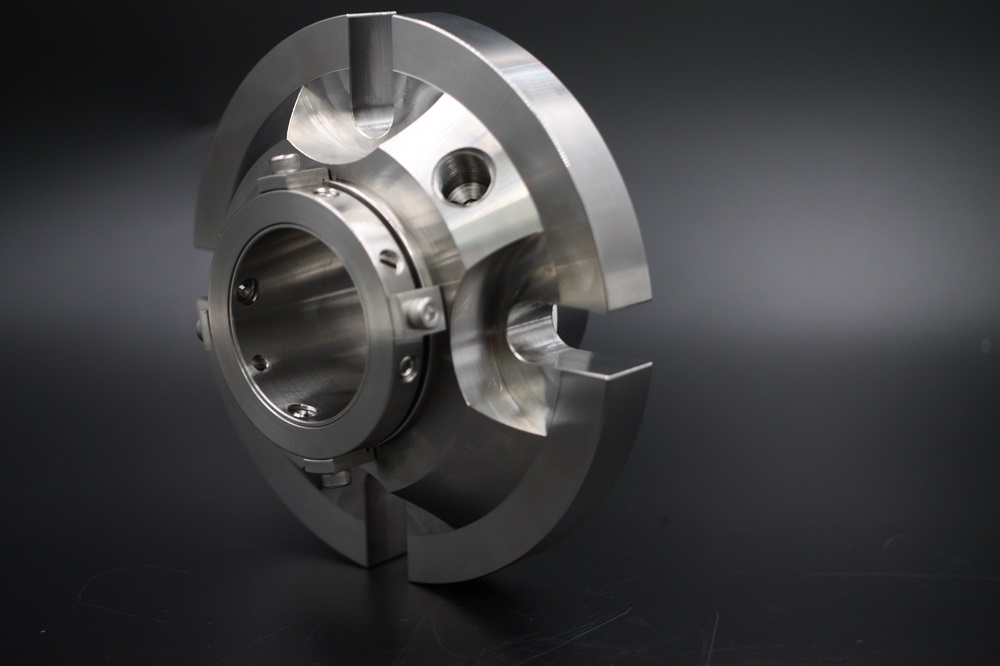
AS-CCSM single seal is to replace AES CSM single cartridge mechanical seal. The seal has the following features:
1. Suitable to ber used on top entry agitator service & vapour applications
2. Can suit different sizes of mixers with long, overhanging shafts
3.Can accept radial movement up to 1.5mm (0.062")
4.Available in a variety of seal face materials, rubber and metal part combinations.
5.Available from sizes 1.000"to 5.000"(24mm - 125mm) or even larger

About Us:


Background Knowledge:
How to choose engineering ceramics & cemented carbide as friction pair material based on the introduced failure forms
Engineering ceramics is one of the indispensable friction pair materials for mechanical seals for corrosion resistance. If it is not selected properly, many problems will arise.The following introduces failure forms using engineering ceramics are prone to and correspondent material selection methods.
1. Fracture
Brittleness is a common disadvantage of all ceramics. Especially edges and corners are easily cracked under impact load. Try to adopt simple shapes in design to avoid sharp corners. Be extremely careful during installation, disassembly, storage and transportation, and there should be no impact load. Overtightening assembly is main reason for fracture of ceramic ring (its strength is 1/4 of that of cemented carbide) of mechanical seal.
Thermal shock is also a common cause of ceramic ring rupture. The mechanical seal may run dry for a short period of time causing temperature rise. When liquid suddenly enters the sealing interface, the ceramic ring suddenly cools down, causing unbearable thermal stress and damages occur.
Therefore, no matter what kind the said ceramics is, we must consider its resistance to sudden temperature changes which often occurs during operation of mechanical seals. Under high temperature conditions, if sudden cooling often occurs, it is best not to use alumina ceramic. Alumina ceramics with a purity of 95% are easy to crack. Higher-purity alumina ceramic ring with a finer particle size is not easy to break.
In order to make up for the shortcoming of low strength, an inlay structure can be used. In order to prevent the ring from falling off the mechanical seal, titanium alloy materials are often used as ring seat, and interference is generally selected in range of 0.05~0.08mm. In this way, the ceramic ring is prevented from breaking or falling off, and the sameness of the two materials in terms of corrosion resistance can be maintained.
Although mechanical strength of ceramic materials is low, if structure design is reasonable, and use and operation are proper, service life is still long under given working conditions.
2. Pair performance
Silicon nitride ceramics are selective as materials for friction pairs of mechanical seals. For example, when it is paired with glass-fiber-filled PTFE in dilute sulfuric acid, it has a large abrasion, and effect is better when paired with carbon graphite;The best effect is when chrome corundum ceramics are paired with glass fiber filled PTFE. The combination of silicon nitride ceramics vs silicon nitride ceramics not only has large wear, but also has large leakage, so only suitable for use under low load conditions.The combination of silicon carbide ceramic and carbon graphite can be used in high load conditions.
Although there are many materials used as friction pairs, it is not easy to determine the appropriate combination of materials for mechanical seal friction pairs. From the perspective of compatibility of material pair, abrasion resistance, etc., it is often necessary to pass a large number of bench tests and accumulation of experience in field applications to determine optimal combination of friction pairs. In addition, reasonable structural design is needed to give full play to excellent performance of the material.
The following briefly talks about how to choose cemented carbide as friction pair material.
Although combination of cemented carbide has good performance, its combination of performance is also selective depending on different working conditions.
If cobalt-based cemented carbide is paired with each other, the end face of the mechanical seal is prone to hot cracks in high-temperature situations; if nickel-based and cobalt-based cemented carbides are paired, this condition can be improved.
Carbides in cemented carbide are generally resistant to most acid and alkali at room temperature. Cobalt-based cemented carbides that use cobalt as a binder have poor corrosion resistance and are easy to be oxidized, so corrosion resistance characteristic is not ideal, and adhesion, corrosion and abrasion are prone to occur.
The hot water pump should use nickel-based cemented carbide. For example, life of nickel-based cemented carbide and carbon graphite pair is twice as long as cobalt-based cemented carbide and carbon graphite pair. When the pump is out of service for a long period of time, its starting torque using the latter materials is about 4 times that using the former materials.
Send Message
Related Products