Español
 Pусский



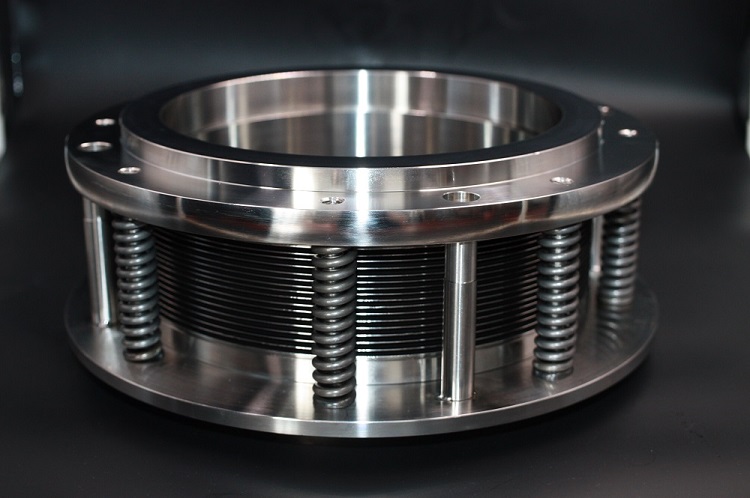
AS-B425 seal is customized metal bellow mechanical seal whose bellows material is AM350. At present, the high temperature bellows material used in the world is AM350. AM-350 is a typical precipitation hardening stainless steel. AM-350 shows unique superiority in process performance, and is a good material for making welded bellows. However, the use temperature is preferably below 315°C.

About Us:
Asinoseal has evolved far beyond the original role as a manufacturer of mechanical seals . The motivation as the foundation of our vision to lead the market in providing high quality products & services can also be called our mission. Our team members’ wealth of knowledge and experience has made them highly qualified and motivated. Whether the questions you throw out is what are differences between centrifugal pump,submersible pump & vacuum pump,or what seal material can be best in make mechanical bellows,Our professional team can always answer in an instant very fluently. You’re welcomed to test our confidence!


Background Knowledge:
What materials are used for the bellows of the metal bellow mechanical seals
(1) What material is used for the bellows of the mechanical seal working at high temperature
For metal bellows mechanical seals, different bellows materials determine whether the mechanical seal can adapt to high temperature or low temperature, high pressure or some other working condition parameters. This article intends to discuss what materials should be used for metal bellows working at high temperatures.
At present, the high temperature metal bellows material used in the manufacturer of mechanical seals world is AM350. AM350 is a precipitation hardening stainless steel. The so-called precipitation hardening refers to the hardening effect caused by the precipitation of another phase in a supersaturated solid solution under certain conditions.
Precipitation-hardening stainless steel is a kind of ultra-high-strength high-alloy steel, usually containing more than 12% chromium, and the total content of alloy elements is about 22%~25%.After high-temperature solution treatment, the austenite structure is maintained when cooled to room temperature, suitable for processing and forming, and then intermediate treatment and cold treatment (-73°C) can be transformed into martensite structure, and then dispersed carbides and other intermetallic compounds are precipitated after aging treatment ,so as to achieve the purpose of higher strength and hardening. So it is also called age hardening,or generally called precipitation hardening.
AM-350 is a typical precipitation hardening stainless steel, its chemical composition is shown in figure 1 below, and its mechanical properties and durable strength are shown in figures 2 and 3 below.
C | Si | Mn | Cr | Ni | Mo | Fo |
0.10 | 0.40 | 1.00 | 16.5 | 4.25 | 2.75 | 余量 |
Figure 1 Chemical Composition of AM-350 %
σb· k | σb MPa | 50.8 mm,% | HRC |
1207 | 1420 | 12 | 45 |
Figure 2 Mechanical properties of AM-350
Heat treatment state: re-solution + (-73 )℃ freezing + aging at 850 ℃ for 1-2 h
427 ℃ | 482 ℃ | ||
100 h | 1000 h | 100 h | 1000 h |
Figure 3 Persistence of AM-350, MPa
AM-350 shows unique advantages in terms of process performance. After solid solution, it has the advantages of austenitic steel (easy cold forming), and then has the characteristics of martensitic steel (high strength and hardness) after strengthening treatment. , and the heat treatment temperature is not high, without the disadvantages of deformation and oxidation, so it is a good material for making welded bellows thus also for making welded bellow mechanical seals.
However, when this type of steel is used for a long time at a temperature above 315°C, the material will become brittle due to the continued precipitation of intermetallic compounds, so the use temperature is best below 315°C.
(2 ) What material is used for the corrosion-resistant and high-temperature resistant bellows in the mechanical seal?
If the metal bellows mechanical seal is to be more resistant to high temperature than ordinary mechanical seals, it is mainly to focus on the material of the welded bellows.
Bellows working under high temperature and corrosive conditions can be made of high nickel alloys, such as Monel, Hastelloy and Inconel. Among them, Inconel 718 is a commonly used grade. It is high temperature resistant, corrosion resistant and has good elasticity. It is the most commonly used material for metal bellows in mechanical seals. Its normal chemical composition and mechanical properties are shown in the following two figures.
21 ℃ | 538 ℃ | 649 ℃ | 732 ℃ | 760 ℃ | ||
Endurance Strength KGF/MM2 | 100 h 1000 h | —— | —— | |||
Tensile Strength KGF/MM2 Yield Strength(0.2 %),KGF/MM2 Elongation % | 130 107.6 22 | 116.7 96.3 26 | 106.5 88.6 15 | —— —— —— | 69 64 8 | |
Figure 1 Mechanical properties of Inconel 718 sheet
Note: The state of the tensile strength test material is 927 ℃ for 1 hour, air cooling + 718 ℃ for 8 hours, furnace cooling + 620 ℃ for 16 hours, air cooling
C | Si | Mn | Cr | Mo | Nb | Ti | Al | Fe | Ni |
0.04 | 0.30 | 0.20 | 18.6 | 3.1 | 5.0 | 0.9 | 0.4 | 18.5 | Remaining amount |
Figure 2 Chemical Properties of Inconel 718 sheet
If we do a comparison between lnconel 718 and AM-350, the former belongs to nickel-based superalloy, and the latter is high-temperature and high-strength precipitation hardening stainless steel. Although both are common materials for making bellows of metal bellow mechanical seals, the price of lnconel 718 is much higher than that of AM-350. Another advantage of lnconel 718 as a high-grade bellows material is that it has stronger corrosion resistance than AM-350, which makes it widely used not only in the petroleum industry but also in the chemical industry, while AM-350 is used in refineries usually.
Send Message
Related Products