Español
 Pусский

Difficulties are posed by high-temperature, low-temperature and easy-to-vaporize medium pump seals(mechanical seals) in the petrochemical industry. In the previous article, we have already talked about the forms, causes and part solutions for the mechanical seal failures of the thermal oil pumps. This article will continue to talk about other measures in two parts.
1. How can the hot oil pumps adopt double mechanical seals to achieve good results?
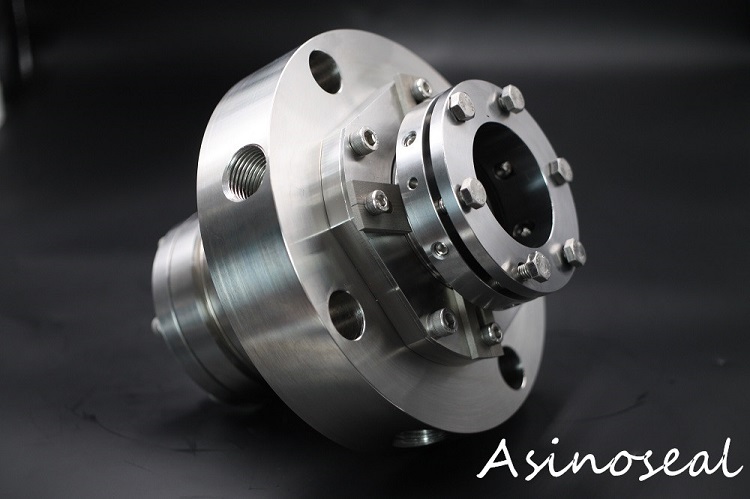
Two single sealing faces form a double mechanical seal, and a sealed chamber is formed between them to separate the medium in the pump from the atmosphere. There must be flushing facilities in the sealed room of the mechanical seal, and circular flushing is generally used.
Two single sealing faces form a double mechanical seal, and a sealed chamber is formed between them to separate the medium in the pump from the atmosphere. There must be flushing facilities in the sealed room of the mechanical seal, and circular flushing is generally used.
Each single mechanical seal can be an ordinary mechanical seal or a bellows type mechanical seal. The circular flushing method can be achivevd by installing a small impeller on the shaft to circulate the sealing liquid and then return to the sealing chamber after cooling; Thermosiphon flushing can also be adopted to use the density difference flow caused by the temperature difference of the mechanical sealing liquid, and then returning to the sealing chamber after through external cooling Chamber; Circular flushing can also be achieved with an external supply of flushing fluid.
The structure of the double mechanical seal is complicated, the installation is difficult, and it is rarely used. According to the survey of 24 petrochemical plants and oil refineries in the United States, among the high-temperature pump shaft seals, only 4% of the pumps use double mechanical seals, and the service life is generally 1.5 to 2 times that of single mechanical seals.
If you want to view other products,pls visit this website & component seals
2. How to apply "hard to hard" sealing materials on the mechanical seal of the thermal oil pump
Most of the general sealing starts from the method of improving the environment, turning the harsh working environment into an acceptable environment. The so-called "hard to hard" seal starts from another angle and improves the material grade of the friction pair of the mechanical seal so that it can adapt to harsh working conditions and achieve the purpose of sealing. The commonly used friction pair material is tungsten carbide, and some materials such as silicon carbide are used. The sealing structure is still the original ordinary mechanical seal. Tungsten carbide has high hardness and strength, and its performance has little change below 400 °C. The solid particles in the medium cannot wear the tungsten carbide, the smoothness of the sealing surface will not be damaged, and good sealing performance of the mechanical seal can be maintained. In addition, tungsten carbide has good thermal conductivity, and its coefficient of linear expansion is also very small, only 1/4~1/3 of that of ordinary carbon steel. Good thermal conductivity and small linear expansion coefficient enable tungsten carbide to work at high temperature, with small thermal deformation, and the flatness of the sealing end surfaces of the mechanical seal will not be damaged, which is also conducive to maintaining good sealing. This kind of friction pair of the mechanical seal is especially suitable for media with high viscosity and a small amount of solid particles. It can work well without flushing, but the gland needs to be cooled by low-pressure steam or hot water.
Most of the general sealing starts from the method of improving the environment, turning the harsh working environment into an acceptable environment. The so-called "hard to hard" seal starts from another angle and improves the material grade of the friction pair of the mechanical seal so that it can adapt to harsh working conditions and achieve the purpose of sealing. The commonly used friction pair material is tungsten carbide, and some materials such as silicon carbide are used. The sealing structure is still the original ordinary mechanical seal. Tungsten carbide has high hardness and strength, and its performance has little change below 400 °C. The solid particles in the medium cannot wear the tungsten carbide, the smoothness of the sealing surface will not be damaged, and good sealing performance of the mechanical seal can be maintained. In addition, tungsten carbide has good thermal conductivity, and its coefficient of linear expansion is also very small, only 1/4~1/3 of that of ordinary carbon steel. Good thermal conductivity and small linear expansion coefficient enable tungsten carbide to work at high temperature, with small thermal deformation, and the flatness of the sealing end surfaces of the mechanical seal will not be damaged, which is also conducive to maintaining good sealing. This kind of friction pair of the mechanical seal is especially suitable for media with high viscosity and a small amount of solid particles. It can work well without flushing, but the gland needs to be cooled by low-pressure steam or hot water.