Español
 Pусский

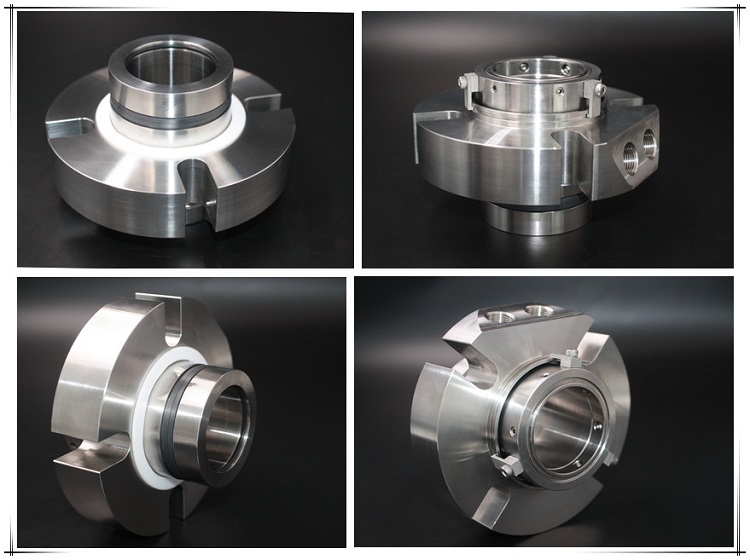
The friction pair of the mechanical seal mainly relies on the cooperation of two smooth surfaces (that is, the rotary face and the stationary seat) and the coolant (usually oil or water), and forms a sealing oil film during the rotation process to withstand a certain specific pressure and thus achieve sealing. Any scratches, cracks or other problems affecting the sealing effect on any of these two surfaces will directly lead to the destruction of the oil film and the leakage of the seal.
Usually, cemented carbide, silicon carbide, graphite, ceramics and other materials are selected to produce the sealing rings.Due to their simple grinding process, they will not have too much influence on the surface of the finished rotary face or stationary seat.However, due to the complicated process of processing the friction surface by spraying, leakage often occurs in the static pressure sealing test of the finished mechanical seal.This is caused by the following reason in terms of details:whether the coating can be firmly and evenly bonded to the substrate directly determines whether the friction pair can play a sealing role, especially the surface of the friction pair whose diameter is greater than 50mm; due to the complicated spraying process, its working temperature curve cannot be very good,while after the final grinding process, stretch marks, spider webs or bulging are prone to occur, and under normal circumstances, such defects cannot be identified with the naked eye or by hand.Although such a sealing surface forms a multi-line seal, the friction surface cannot form a good oil film to withstand a larger pressure(the pressure that can be endured is usually less than 0.01MPa).
 (If you want to view other products,pls visit this website & component seals)
The easiest way to check for such processing defects is to use a magnifying glass (above 8 multiple) in a sunny place to observe through the spectrum reflected by the surface. The dynamic or static ring that finds such problems should be replaced in time.
Another method is to use an optical flat mirror with a sodium lamp for spectral analysis. Since this method requires high equipment costs and requires professionals to operate, it is difficult to popularize in
general enterprises.
Usually, cemented carbide, silicon carbide, graphite, ceramics and other materials are selected to produce the sealing rings.Due to their simple grinding process, they will not have too much influence on the surface of the finished rotary face or stationary seat.However, due to the complicated process of processing the friction surface by spraying, leakage often occurs in the static pressure sealing test of the finished mechanical seal.This is caused by the following reason in terms of details:whether the coating can be firmly and evenly bonded to the substrate directly determines whether the friction pair can play a sealing role, especially the surface of the friction pair whose diameter is greater than 50mm; due to the complicated spraying process, its working temperature curve cannot be very good,while after the final grinding process, stretch marks, spider webs or bulging are prone to occur, and under normal circumstances, such defects cannot be identified with the naked eye or by hand.Although such a sealing surface forms a multi-line seal, the friction surface cannot form a good oil film to withstand a larger pressure(the pressure that can be endured is usually less than 0.01MPa).
The easiest way to check for such processing defects is to use a magnifying glass (above 8 multiple) in a sunny place to observe through the spectrum reflected by the surface. The dynamic or static ring that finds such problems should be replaced in time.
Another method is to use an optical flat mirror with a sodium lamp for spectral analysis. Since this method requires high equipment costs and requires professionals to operate, it is difficult to popularize in
general enterprises.