Español
 Pусский
Due to limited spaces, or high costs of auxiliary facilities, and in some cases, materials do not allow sealing liquid or flushing water to enter the product, a new type of mechanical seal structure that can be directly used in granular media is designed. Depending on different situations, different measures are as follows:
In the first case, both springs and auxiliary sealing rings for mechanical seals are used. The main advantages are: high elasticity, and the problem of the spring(s)being easily blocked by particles can be avoided since the sproing is not in contact with the medium.
In this case,in order to ensure that the friction pair of the mechanical seal can be wear resistant and corrosion resistant, hardness of the friction pair material must be higher than that of the particles. Hard-to-hard pairs are usually chosen, and the material can be tungsten carbide or silicon carbide. Compared with tungsten carbide, silicon carbide has higher hardness degree, better thermal conductivity, better chemical stability, and self-lubrication, but the cost is also higher.
According to the conclusion drawn by A.I.GoLubiev (the former Soviet Union) and others on the wear mechanism of high-hardness friction pairs in abrasive granular media, the width of friction pairs should be wider than that of general mechanical seals to obtain higher service life. The width of the dynamic and static rings is equal, which is beneficial to prevent the wear of the sealing end face by the particles, and at the same time, there is enough area to avoid large mismatch. Therefore, it can suit much larger radial and axial runout than that of general mechanical seals.
In the case of mixed-flow pumps,mechanical seals should be designed as internal flow type so that centrifugal force and inertial force make the particles and impurities which is on the outside of the sealing ring move outward and leave the sealing surface.
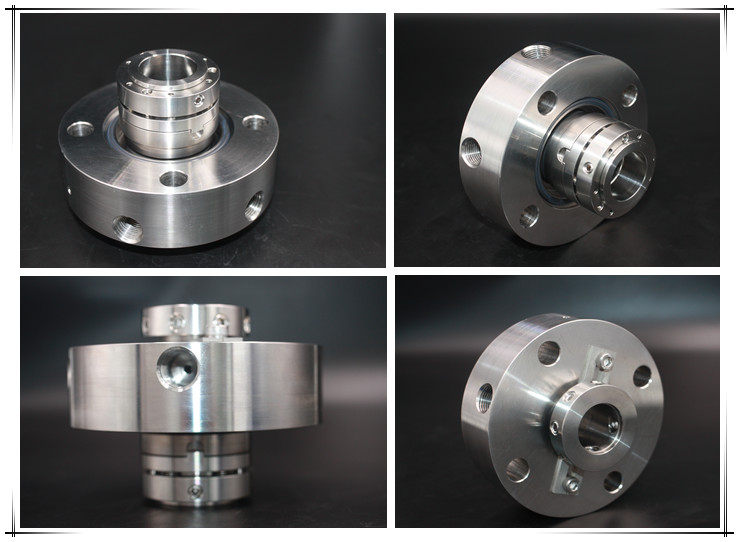
( If you want to view other products,pls see this website & component seals)
At the same time, the gap between the shaft sleeve and the sealing ring should be large,so that leaked material can be discharged in time to avoid accumulation and blockage of particles. The sealing cavity must have large enough space, so that the material in it can flow without accumulation of sediment, and it is easy to cool and lubricate the mechanical seal. In order to reduce the influence of the medium pressure in the pump on specific pressure of the sealing end faces, a balanced mechanical seal structure should be adopted.
In order to prevent the particle medium from entering the sealing end faces, which will lead to increased leakage and aggravated end face wear, resulting in failure of the mechanical seal, end face specific pressure should be larger. However, if the specific pressure value is too large, the friction surface will heat up and wear more, and power consumption will increase. That’s why when designing, end face specific pressure should be set about 0.3MPa.
When a single mechanical seal is used, to avoid harm of particulate impurities, measures such as washing, filtration, separation, isolation, heat preservation and heating and so on should be taken according to different situations. Reliability and quality of the flushing fluid is key to sealing effects of the mechanical seal. Thus If cleansing & flushing fluid is injected from outside, the sealing working environment can be improved at the expense of the flushing fluid, and on the premise that the delivered fluid is allowed to be slightly diluted by the flushing fluid.
When a double mechanical seal is used, the sealing liquid is required to build up pressure in the sealing cavity for sealing, lubrication and cooling cycles. The double-face seal has high reliability, but the manufacturing cost and installation cost are high. The combination choice of materials is standardized for most double mechanical seals. In actual use, the friction pair at the medium end can be made of cemented carbide pair or silicon carbide pair; the friction pair at the atmospheric end can be made of carbon graphite and nickel-chromium steel.
In the first case, both springs and auxiliary sealing rings for mechanical seals are used. The main advantages are: high elasticity, and the problem of the spring(s)being easily blocked by particles can be avoided since the sproing is not in contact with the medium.
In this case,in order to ensure that the friction pair of the mechanical seal can be wear resistant and corrosion resistant, hardness of the friction pair material must be higher than that of the particles. Hard-to-hard pairs are usually chosen, and the material can be tungsten carbide or silicon carbide. Compared with tungsten carbide, silicon carbide has higher hardness degree, better thermal conductivity, better chemical stability, and self-lubrication, but the cost is also higher.
According to the conclusion drawn by A.I.GoLubiev (the former Soviet Union) and others on the wear mechanism of high-hardness friction pairs in abrasive granular media, the width of friction pairs should be wider than that of general mechanical seals to obtain higher service life. The width of the dynamic and static rings is equal, which is beneficial to prevent the wear of the sealing end face by the particles, and at the same time, there is enough area to avoid large mismatch. Therefore, it can suit much larger radial and axial runout than that of general mechanical seals.
In the case of mixed-flow pumps,mechanical seals should be designed as internal flow type so that centrifugal force and inertial force make the particles and impurities which is on the outside of the sealing ring move outward and leave the sealing surface.
( If you want to view other products,pls see this website & component seals)
At the same time, the gap between the shaft sleeve and the sealing ring should be large,so that leaked material can be discharged in time to avoid accumulation and blockage of particles. The sealing cavity must have large enough space, so that the material in it can flow without accumulation of sediment, and it is easy to cool and lubricate the mechanical seal. In order to reduce the influence of the medium pressure in the pump on specific pressure of the sealing end faces, a balanced mechanical seal structure should be adopted.
In order to prevent the particle medium from entering the sealing end faces, which will lead to increased leakage and aggravated end face wear, resulting in failure of the mechanical seal, end face specific pressure should be larger. However, if the specific pressure value is too large, the friction surface will heat up and wear more, and power consumption will increase. That’s why when designing, end face specific pressure should be set about 0.3MPa.
When a single mechanical seal is used, to avoid harm of particulate impurities, measures such as washing, filtration, separation, isolation, heat preservation and heating and so on should be taken according to different situations. Reliability and quality of the flushing fluid is key to sealing effects of the mechanical seal. Thus If cleansing & flushing fluid is injected from outside, the sealing working environment can be improved at the expense of the flushing fluid, and on the premise that the delivered fluid is allowed to be slightly diluted by the flushing fluid.
When a double mechanical seal is used, the sealing liquid is required to build up pressure in the sealing cavity for sealing, lubrication and cooling cycles. The double-face seal has high reliability, but the manufacturing cost and installation cost are high. The combination choice of materials is standardized for most double mechanical seals. In actual use, the friction pair at the medium end can be made of cemented carbide pair or silicon carbide pair; the friction pair at the atmospheric end can be made of carbon graphite and nickel-chromium steel.