Español
 Pусский


Pump seals are not a single component, but a family that covers multiple principles and adapts to different working conditions. From the most traditional packing seal to highly engineered mechanical seals, and then to sealless pumps that fundamentally eliminate leakage points, choosing which one to use is essentially a balance between cost, leakage tolerance, and harsh operating conditions. Different types of pump seals correspond to different scenarios.
1. Traditional cornerstone: packing seal
This is the oldest and most recognizable form of sealing in history. It achieves sealing by filling the stuffing box with woven or molded flexible materials (such as graphite, PTFE, aramid fibers) and relying on the axial pressure of the cover to make it tightly adhere to the rotating shaft.
Its core feature is to allow controlled leakage. During operation, a leakage rate of 10 to 30 drops per minute is usually required to lubricate and cool the packing itself. This determines that it is suitable for situations with clean water, low pressure, low temperature, and insensitivity to leaks. Its advantages lie in its simple structure, extremely low cost, and easy maintenance. Therefore, it is more adaptable than precision mechanical seals in working conditions with high impurities such as mine drainage - impurities are less likely to cause catastrophic failure.
2. Main Performance: Mechanical Seal
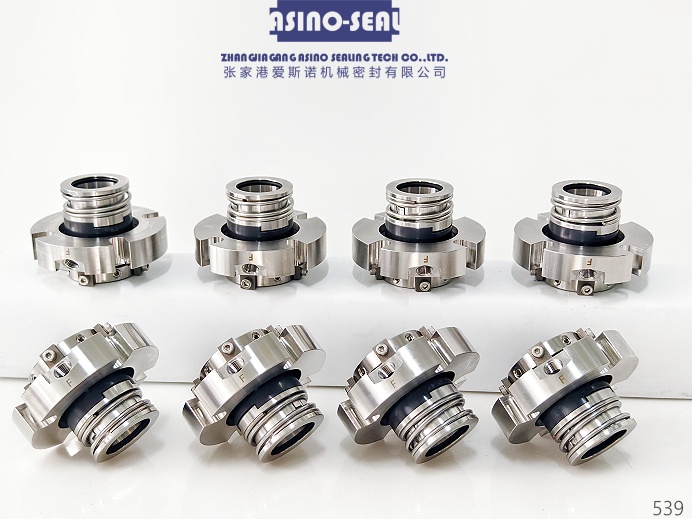
Mechanical seal is the most widely used high-performance sealing solution for modern centrifugal pumps, with its core being a precision end face friction pair perpendicular to the axis.
A dynamic ring that rotates with the axis and a static ring fixed on the pump casing are tightly fitted under the combined action of spring force and medium pressure. The extremely thin liquid film formed between the two achieves extremely low leakage, even close to zero leakage, during relative sliding. Unlike the direct friction shaft of the packing seal, the wear of the mechanical seal occurs on the replaceable ring, and the shaft itself is protected.
Mechanical seals themselves are a large family that can be further subdivided according to different dimensions:
a. Quantity and arrangement of massage wipes
Single end face
Double end face
b. According to the structural form
skid-mounted
Non containerized
c. According to the pressure balance method
Balanced
Unbalanced type
d. According to the elastic element
spring-type
Bellows type
e. Solutions for abrasion and high-risk media
Dynamic seal
Leak free pump
magnetic drive pump
canned motor pump
3. Other specialized and auxiliary types
Lip seal (oil seal)
labyrinth seal
dry gas seal
In summary, the core of different types of pump seals is as follows: they are essentially a trade-off between leakage control, operating condition tolerance, cost, and maintenance complexity.