Español
 Pусский

Auxiliary facilities for mechanical seals refer to lubricating, cooling or temperature-regulating, flushing, purifying, diluting and flushing away the leakage medium to improve the working environment of the mechanical seal by means of flushing, cooling, filtering and separation. The primary mode of operation of all ancillary facilities is flushing.
The flushing pressure should be appropriate, if the pressure is too low, the flushing fluid cannot enter the sealed cavity. If the flushing pressure is too high, the amount of flushing injected will be too large, which wastes energy.In the case of injection flushing, if the injection volume is too much, a large amount of sealing liquid will enter the pump, which is not good for production. Therefore, requirements are placed on flushing pressure.
The flushing pressure is related to the flushing method, medium pressure and pressure changes. For the current pump mechanical seal working pressure below 2MPa, the flushing pressure is 0.05~0.20MPa higher than the pressure in the sealing cavity when the pressure change is not large but relatively accurate, and the difference is 0.1~0.2MPa. For self-flushing using a flow-restricting orifice, no further provision is made.
So, how to determine the pressure in the sealed cavity of the mechanical seal? The pressure in the seal chamber is related to the support structure of the pump, and the pressure in the seal chamber of double-support and cantilever pumps is different. It is also related to the position of the pump suction port and the balance method of the axial force, in addition to the wear and lift of the pump. For double support pumps, single-stage double-suction impellers, the pressure in the seal chamber at both ends is equal to the inlet pressure of the pump; for two-stage double-branch pumps, the pressure in the seal chamber at the inlet end is equal to the inlet pressure of the pump, and the pressure in the seal chamber at the outlet end is equal to the outlet pressure of the first-stage impeller (that is, the inlet pressure of the second-stage impeller),namely half of the sum of the outlet and inlet pressures. For multi-stage double-support pumps with balance discs (drums) to balance the axial force: the pressure of the seal chamber at the inlet end is equal to the inlet pressure of the pump. The pressure of the sealing chamber at the outlet end depends on the radial clearance of the balance drum. When the (diameter) gap is 0.4~0.5mml, the pressure in the sealing chamber is 0~0.05MPa higher than the pump inlet pressure; when the gap is 0.55~0.7mm, the pressure in the sealing chamber is 0.1~0.2 higher than the pump inlet pressure MPa, when the gap is 0.75~0.90mm, the pressure in the seal chamber is 0.25~0.35MPa higher than the pump inlet pressure. For the multi-stage double-supported pump whose impellers are symmetrically arranged to balance the axial force, the pressure of the sealing chamber at the inlet end is equal to the inlet pressure of the pump. The pressure of the sealed chamber at the outlet end is numerically equal to the formula:
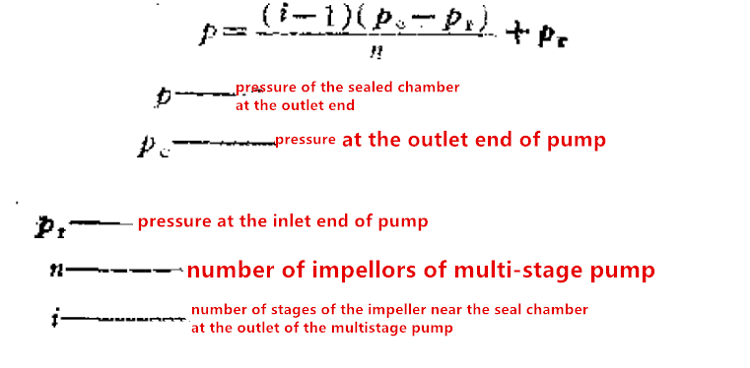
For cantilever two-stage pumps (such as 80Y-100×2), the pressure in the sealing chamber of the mechanical seal is equal to the inlet pressure of the pump; for cantilever single-stage pumps, the pressure in the sealing chamber is also balanced with the axial force and the impeller and pump body related to the mouth ring gap. For cantilever pumps with balance holes in the impeller, when the mouth ring clearance is small, it is basically equal to the inlet pressure of the pump. When the mouth ring clearance is large, the pressure in the seal chamber is 0.05~0.1MPa higher than the pump inlet pressure.
For other pumps, the pressure of the seal chamber of the mechanical seal should be determined according to the structure and lift of the pump. It should be noted that it is best to determine the pressure in the sealed cavity by actual measurement. Generally, a pressure gauge is installed near the sealing cavity of the mechanical seal on the flushing pipeline. When the flushing liquid is not introduced, that is, the flushing valve is not opened, the reading of the pressure gauge is the pressure in the sealing cavity.
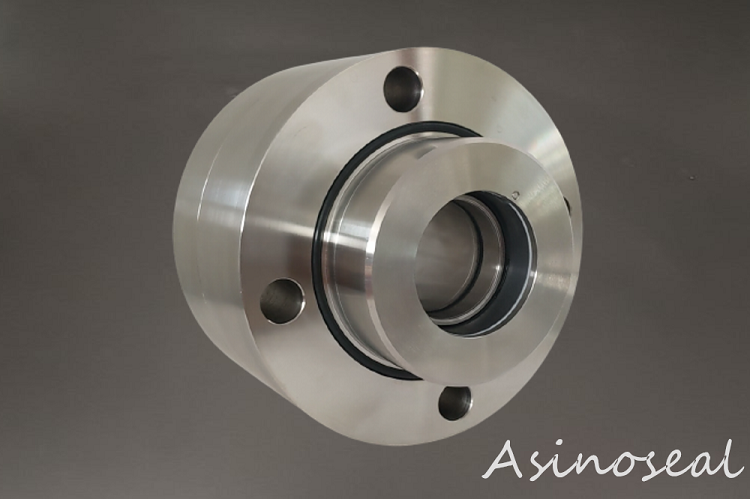
If you want to view other products,pls visit this website & component seals