Español
 Pусский

In the manufacture of mechanical seals, polytetrafluoroethylene is a common material for making seal rings. What are its characteristics and in which working conditions are this type of materials used?PTFE has good corrosion resistance. Its chemical stability is the best among known plastics, so it is known as the "King of Plastics". It is resistant to the corrosion of almost all strong acids, alkalis and strong oxidants. It has been found that only molten alkali metal (or its ammonia solution), elemental fluorine and chlorine trifluoride can react with polytetrafluoroethylene at high temperature. The molecular structure of polytetrafluoroethylene determines that the surface molecules are easy to roll and slide with each other, so when polytetrafluoroethylene is rubbed against other materials, its molecules are first transferred to the mating material, forming a layer on the surface of the mating material a thick film of about 0.02~0.03μm ,so it is an excellent anti-friction, self-lubricating material. PTFE has a low coefficient of friction, its dynamic and static friction coefficients are both 0.04, and its friction coefficient when rubbed against a metal mirror is 0.09~0.12.PTFE has high heat resistance and cold resistance, the service temperature is -18~250°C, and it has good water resistance, aging resistance, non-combustibility, toughness and processing performance.
PTFE also has some disadvantages, and the scope of use in making mechanical seals is limited. The biggest disadvantage is cold flow, that is, creep occurs under load; in addition, the linear expansion coefficient is very large, in the range of 8×10¯5~25×10¯5 1/℃, the values at different temperatures are shown in the figure below , understanding this property is meaningful for temperature control during storage and processing.
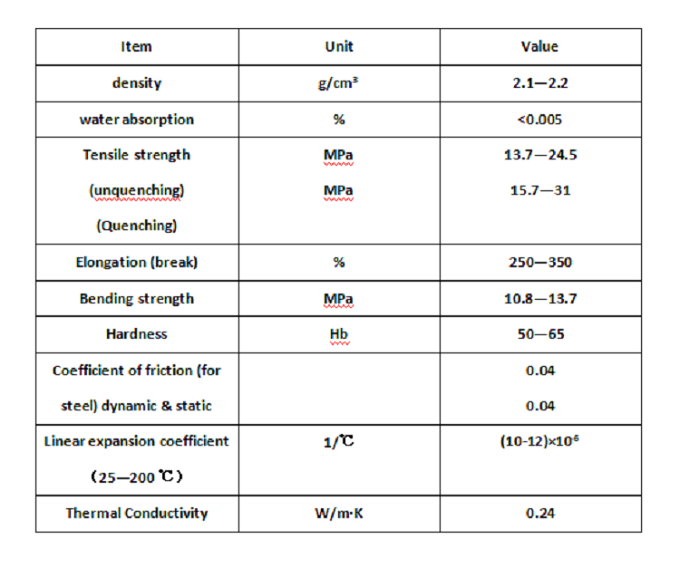
In addition, the thermal conductivity of polytetrafluoroethylene is very poor, which is 0.244W/(m.K) and the difference is more than 300 times that of metal. Therefore, when polytetrafluoroethylene is used as the sealing ring of the mechanical seal, the frictional heat is difficult to be derived, which increases the temperature and deteriorates the sealing performance. Therefore, this kind of sealing ring can only be used in occasions where the pv value is not high and cooling and heat dissipation measures must be taken. Only when the highly corrosive medium competes with other materials and cannot meet the needs can PTFE be used as the sealing ring. However, auxiliary seals are often made of polytetrafluoroethylene. In order to overcome the shortcomings of polytetrafluoroethylene, various additives are often added to improve its performance. When manufacturing sealing rings, silica glass powder is often added to increase dimensional stability and wear resistance. In addition, bronze powder, aluminum disulfide, graphite, etc. are added to improve thermal conductivity and self-lubrication. The filler generally does not exceed 15-20%. The physical and mechanical properties of PTFE are as follows.
If you want to view other products,pls visit this website & component seals