Español
 Pусский
As the most commonly used sealing element of mechanical seals, there are certain tips in designing and using O-ring seals. Mastering these tips can help ensure quality and service life of O-ring seals. This article will briefly describe these tips that are easily overlooked by engineers and technicians.
(1) Correct selection of groove shape
As to groove shapes of the O-ring of the mechanical seal, the most common choice is rectangular groove shape, but as to some special parts such as the rotary sealing part, semi-circular groove shape can be selected;As to its flange and bolt head which are relatively small and narrow, triangular grooves can be used.
(2) Correct selection of O-ring hardness
Reasonable selection of sealing gap and selecting materials with higher hardness can also alleviate phenomenon of intrusion into the gap and prolong the service life of the O ring seal of the mechanical seal. The below table of Relationship between sealing gap, working pressure and O-ring hardness is for your reference.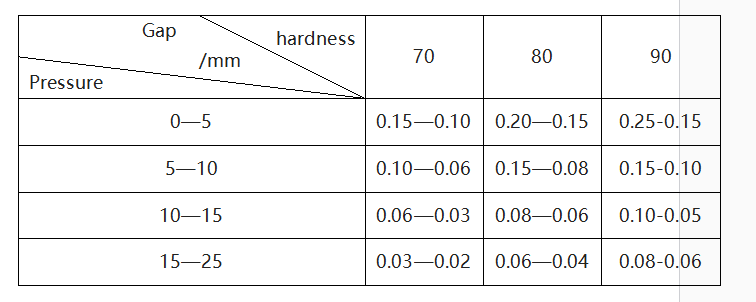 (3) Pressure compensation groove adopted to enhance sealing effect of the mechanical seal
Excessively high pressure of the sealed fluid or hydraulic shock can cause the O-ring to leak. If the pressure exceeds 4MPa, there may be oil leakage. After adding a retaining ring, the pressure can be increased. However, the hydraulic shock will make the local instantaneous pressure several times higher than the normal working pressure, which may cause the O-ring to lose its sealing performance. In this case, a groove with a pressure compensation function can be used.With this kind of groove, no leakage can be achieved even under the pressure of 16MPa. The groove size of this O-ring seal is: the groove width b is 0.2~1mm larger than the wire diameter d1 of the O-ring, the bottom diameter D of the groove is 0.2~2mm smaller than the inner diameter of the O-ring, and 2~4 small holes with a diameter of 2~4mm should be drilled near the bottom of the groove. Besides, a single-acting hydraulic cylinder can be punched at one end, and a double-acting hydraulic cylinder can be punched at both ends.1) The matching clearance between the outer diameter of the piston and the cylinder diameter can be enlarged. The larger the diameter of the o-ring section, the larger the clearance, generally 0.1~0.5mm. The usual seal contact point is at the outer diameter. At this point, as the pressure increases, the contact becomes tighter, which plays a role in pressure compensation. At the same time, there is no greater requirement for the dimensional tolerance of the piston, and the surface roughness is R6.3~3.2um.
 (If you want to view other products,pls visit this website & component seals)
(1) Correct selection of groove shape
As to groove shapes of the O-ring of the mechanical seal, the most common choice is rectangular groove shape, but as to some special parts such as the rotary sealing part, semi-circular groove shape can be selected;As to its flange and bolt head which are relatively small and narrow, triangular grooves can be used.
(2) Correct selection of O-ring hardness
Reasonable selection of sealing gap and selecting materials with higher hardness can also alleviate phenomenon of intrusion into the gap and prolong the service life of the O ring seal of the mechanical seal. The below table of Relationship between sealing gap, working pressure and O-ring hardness is for your reference.
Excessively high pressure of the sealed fluid or hydraulic shock can cause the O-ring to leak. If the pressure exceeds 4MPa, there may be oil leakage. After adding a retaining ring, the pressure can be increased. However, the hydraulic shock will make the local instantaneous pressure several times higher than the normal working pressure, which may cause the O-ring to lose its sealing performance. In this case, a groove with a pressure compensation function can be used.With this kind of groove, no leakage can be achieved even under the pressure of 16MPa. The groove size of this O-ring seal is: the groove width b is 0.2~1mm larger than the wire diameter d1 of the O-ring, the bottom diameter D of the groove is 0.2~2mm smaller than the inner diameter of the O-ring, and 2~4 small holes with a diameter of 2~4mm should be drilled near the bottom of the groove. Besides, a single-acting hydraulic cylinder can be punched at one end, and a double-acting hydraulic cylinder can be punched at both ends.1) The matching clearance between the outer diameter of the piston and the cylinder diameter can be enlarged. The larger the diameter of the o-ring section, the larger the clearance, generally 0.1~0.5mm. The usual seal contact point is at the outer diameter. At this point, as the pressure increases, the contact becomes tighter, which plays a role in pressure compensation. At the same time, there is no greater requirement for the dimensional tolerance of the piston, and the surface roughness is R6.3~3.2um.