Español
 Pусский

The end face friction characteristics of mechanical seals are the key factors that determine the working life and sealing performance of mechanical seals. The performance parameters directly related to the end face friction characteristics of mechanical seals mainly include end face friction torque and so on.
The following briefly talks about the test technology of the friction torque of the mechanical seal end face. At present, the technology mainly includes support-reaction method and transfer method.
The support reaction force method is to measure the friction torque according to the change of the support reaction force generated by the power machinery under the action of torque. The advantages are that there is no problem of signal transmission from the rotating part to the stationary part, and the method for determining the reaction force of the support is simple and easy to implement. EMayer, Li Kun, etc. used the support-reaction force method to measure the friction torque of the mechanical seal end face. A force-measuring rod is arranged on the rotatable sealing cavity, and makes it act on the force sensor, thereby measuring the torque. However, the friction of the rotary support in the sealed cavity will affect the test accuracy, so the requirements for the rotary support are extremely high. Li Kun used aerostatic bearings.
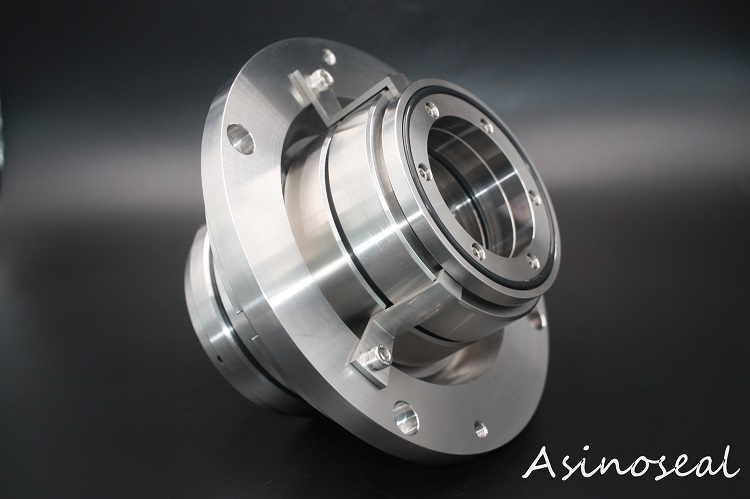 (If you want to view other products,pls visit this website & component seals)
The transmission method measures torque according to the changes in physical parameters produced by elastic elements when transmitting torque. The instrument using the transmission method to measure torque is small and light, and the torque sensor can be directly connected to the transmission system without changing the mechanical system structure. JASilvaggo, Song Pengyun, Zhao Zengshun, etc. install a torque sensor between the motor and the sealing spindle, measure the torque of the rotating shaft, and subtract the friction torque of the main bearing and the stirring torque of the rotating parts in the medium from the measured torque during no-load operation. Thus the mechanical seal end face friction torque can be obtained.
However, this method is not direct enough, and because the working conditions of normal operation and no-load operation are not the same, the results may have large deviations, and the accuracy is difficult to be guaranteed.
The performance parameters directly related to the end face friction characteristics of mechanical seals also include end face wear, end face temperature, etc. Please pay attention to the series of articles.
The following briefly talks about the test technology of the friction torque of the mechanical seal end face. At present, the technology mainly includes support-reaction method and transfer method.
The support reaction force method is to measure the friction torque according to the change of the support reaction force generated by the power machinery under the action of torque. The advantages are that there is no problem of signal transmission from the rotating part to the stationary part, and the method for determining the reaction force of the support is simple and easy to implement. EMayer, Li Kun, etc. used the support-reaction force method to measure the friction torque of the mechanical seal end face. A force-measuring rod is arranged on the rotatable sealing cavity, and makes it act on the force sensor, thereby measuring the torque. However, the friction of the rotary support in the sealed cavity will affect the test accuracy, so the requirements for the rotary support are extremely high. Li Kun used aerostatic bearings.
The transmission method measures torque according to the changes in physical parameters produced by elastic elements when transmitting torque. The instrument using the transmission method to measure torque is small and light, and the torque sensor can be directly connected to the transmission system without changing the mechanical system structure. JASilvaggo, Song Pengyun, Zhao Zengshun, etc. install a torque sensor between the motor and the sealing spindle, measure the torque of the rotating shaft, and subtract the friction torque of the main bearing and the stirring torque of the rotating parts in the medium from the measured torque during no-load operation. Thus the mechanical seal end face friction torque can be obtained.
However, this method is not direct enough, and because the working conditions of normal operation and no-load operation are not the same, the results may have large deviations, and the accuracy is difficult to be guaranteed.
The performance parameters directly related to the end face friction characteristics of mechanical seals also include end face wear, end face temperature, etc. Please pay attention to the series of articles.