Español
 Pусский
Most of the causes of mechanical seal leakage failures are caused by the surface damage of the deflection surface. These surface damages are divided into abnormal wear, thermal cracks, carbon scars and abnormal corrosion wear. There have been many research reports on thermal cracking and corrosion, and the reasons for their occurrence have also been understood by most industry insiders. The conclusion that to reduce the occurrence of leakage failures is to require selecting appropriate sealing structures and durable materials is also easy to draw. Carbon scars are mainly a kind of surface damage on the graphite surface of the mechanical seal whose medium is oil. We can observe round shiny bulges or bulges accompanied by cracks on the surface layer. The generation of this carbon mark is due to the increase in the gap between the sealing surfaces of the mechanical seal and the increase in the obvious leakage. Therefore , in order to further improve the technology of preventing carbon scars, it has become the primary topic of mechanical seal manufacturers.
Past studies have shown that the carbon scar phenomenon is caused by the following reasons: 1. the expansion of pores of the graphite material used as a flexible sheet which has been stuffed with oil stains:2. Thermal decomposition and expansion of the resin impregnated in graphite; 3. Thermal stress caused by local strong contact on the graphite surface;4. other reasons. However, there are many phenomena that are difficult to explain based on past research alone. The author combined the relationship between the surface properties of the material and the friction properties to study the phenomenon of carbon scar formation. The results show that: carbon scars are a kind of subtle damage occuring in the fluid lubrication area of the mechanical seal device, accompanied by y the small protrusions on the graphite surface as the center of the oil film with high viscosity resistance.
The following is a classification of the occurrence of carbon scars, a quantitative evaluation of its impact, especially on the surface characteristics of the mechanical seal and the physical properties of the material, and a detailed discussion on how to prevent the formation of carbon scars.
The experimental results show that the higher the viscosity of the oil (at this time the frequency of frictional torque changes is also the largest), the more easily carbon scars occur, but the relationship of this phemonon with the load and speed of the said mechanical seal is not clear; in addition, the temperature cycle of oil from heating to cooling does not constitute a necessary condition of the occurance. The higher the mechanical strength of graphite of the mechanical seal, the lower the probability of carbon scars; the greater the surface roughness of the graphite ring and the opposite ring of the mechanical seal, the lower the probability of carbon scars. The shape of carbon scar is closely related to the type of graphite material and its forming method.
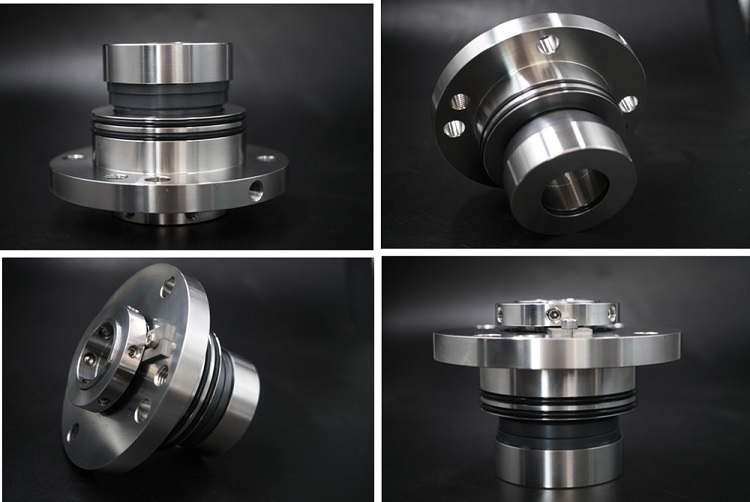
If you want to view other products,pls visit this website & component seals